
The short answer: The most effective way for an occupational therapist to approach a client is to reason before reaching for a tool. Use a practice process framework (like the CPPF, COTIPP, or OTPF-4) to structure your steps, a model (like CMOP-E, PEO, or MOHO) to understand the person, occupation, and environment, then conceptualize the case - analyzing strengths & barriers before choosing interventions.
If you have ever finished an assessment, looked down at your notes, and thought "okay... now what?", this post is for you.
In mentorship sessions, I see a pattern I lovingly call throwing tools at people. A client comes in with fatigue, poor sleep, and trouble getting back to work. Within a session or two, they have a sleep hygiene handout, a pacing sheet, a grounding exercise, and a home program. Some of it helps. Some of it doesn't. And nobody, including the therapist, is quite sure why.
I want to be really clear: this approach usually comes from caring a lot, wanting to help quickly, and working in systems that reward visible action. OTs want to have tangible proof of value delivered in their sessions in time to write that dreaded progress report.
But OTs often seek mentorship because throwing tools at people doesn’t feel good. Mentees often describe a state of confusion & concern - they are not sure if they are doing the right thing at the right time for the client, and they are not sure how to find out. They feel untethered, and when I ask questions like why did you choose X over Y, the answer is I don’t know. This ultimately is distressing for the OT and can add to that sense of imposter syndrome that can persist into the first handful of years of practice or beyond.
The good news? There is a way out, and it is already sitting in our profession's foundations. In professional mentorship sessions, the shift we work on together is moving from tool-first to reasoning-first: case conceptualization, barriers analysis, practice processes, and theoretical models and frameworks.
In this post, you will learn:
The difference between models, frames of reference, frameworks, and concepts (in plain language)
How practice process frameworks like the OTPF-4, CPPF, and COTIPP give you a map
What case conceptualization and barriers analysis look like with a real-world style example
A step-by-step way to approach your next client with confidence
Why do occupational therapists end up throwing tools at clients?
Tool-first practice usually comes from time pressure, a deep wish to help, and theory we learned in the first few months of school but never linked to our real-world caseload.
When I sit with mentees, the reasons sound a lot like this:
Productivity pressure. When you have back-to-back sessions, handing over a worksheet feels like visible, billable progress.
Theory that stayed in school. Many of us learned models for exams, then rarely heard them named again in the clinic.
Course-collecting. Continuing education is often tool-heavy, so we come back with a new technique and look for someone to try it on.
Fear of not being helpful. Sitting with the problem instead of rushing to the solution is uncomfortable.
An unclear role on the team. If you are not sure what OT uniquely offers in a setting, it is easy to borrow everyone else's interventions.
I know this one from the inside. Earlier in my career I took course after course and collected a long list of certifications, and I still felt stuck. The moment a new skill didn't work exactly like it did in the case study, I was my own worst enemy. (Spoiler: it never goes exactly like the case study.)
In her post on models, frames of reference, and concepts, occupational therapist Rachel Booth reflects that experienced OTs often absorb frameworks into their reasoning without ever revisiting the theory underneath. This can easily happen as our busy clinic days are full of back to back appointments, and don’t leave us time to slow down and name our thinking.
What does tool-first practice cost?
It costs our clients, and it costs us.
For clients: care can feel fragmented, buy-in drops when strategies do not connect to what they care about, and it gets hard to tell what is actually working.
For you: every session feels like starting from scratch, you struggle to explain your rationale to funders or the team, and you carry the weight of guessing. You worry if you are being an effective clinician, lacking the structure and framework to build an intervention plan based on clinical reasoning.
Here is the reframe I offer mentees: When you know the reason behind what you are doing, you can let go of the pressure to have the perfect tool.
What is the difference between a model, a frame of reference, and a concept in occupational therapy?
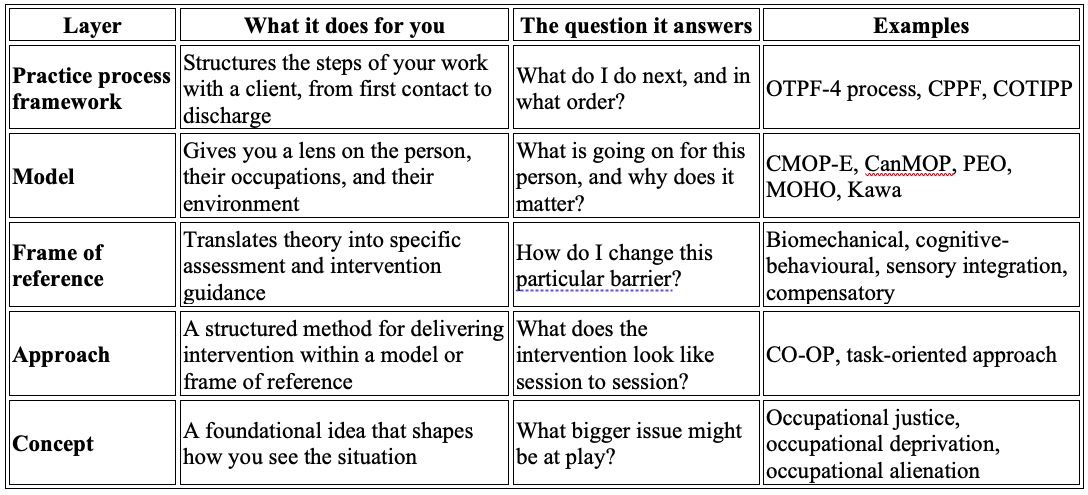
A model explains why occupation matters and what to look at. A frame of reference guides how to assess and intervene. A concept is a core idea inside both.
These words get used interchangeably, which is a big part of why they feel slippery. Here is how I explain them to mentees, drawing on Rachel Booth's breakdown and the categories used in the OT Theory database:
An everyday way to hold it
Think of planning a road trip:
The practice process framework is your itinerary. It tells you the stops and the order.
The model is your map. It shows the whole landscape, including the detours and the washed-out bridges.
The frame of reference is your vehicle for a particular stretch. A kayak for the lake, hiking boots for the trail.
The tools are what is in your backpack.
Tool-first practice is like packing the backpack before you know where you are going. Everything in it might be useful. It just might not be useful on this particular trip.
Why the labels sometimes blur
You will see the same theory labelled differently depending on the source. Booth notes, for example, that Reed and Sanderson's work is called a model but functions more like a frame of reference, and that Ayres Sensory Integration sits best as a frame of reference because it gives structured assessment and intervention guidance.
My practical advice: do not get stuck on the label. Ask what job the theory is doing for you right now. Is it helping you understand the person (model), or telling you how to intervene on a specific barrier (frame of reference)?
What are practice process frameworks in occupational therapy?
Practice process frameworks lay out the actions an OT takes with a client.
If models are your map, process frameworks are your itinerary. They are the antidote to "okay... now what?" because they always tell you where you are and what comes next. Here are three that I keep at the front of my mind.
The OTPF-4 (AOTA)
The Occupational Therapy Practice Framework, 4th edition (AOTA, 2020) describes two things: our domain and our process.
Domain is what OT is "in charge of": occupations, contexts, performance patterns (habits, routines, roles, rituals), performance skills (motor, process, social interaction), and client factors (values, beliefs, spirituality, body functions and structures).
Process has three parts: evaluation, intervention, and outcomes. AOTA highlights clinical and professional reasoning, therapeutic use of self, and occupational and activity analysis as key features of that process.
Why it helps a lost clinician: the domain is a ready-made checklist. If you have only looked at client factors (pain, range of motion, mood), the OTPF-4 nudges you to ask about routines, roles, and context too.
The Canadian Practice Process Framework (CPPF)
The CPPF comes from Enabling Occupation II (Townsend and Polatajko, CAOT, 2007). It has eight action points:
Enter/initiate
Set the stage
Assess/evaluate
Agree on objectives and plan
Implement plan
Monitor/modify
Evaluate outcome
Conclude/exit
Those action points sit inside three contextual layers: the societal context, the practice context, and your frame(s) of reference, which can shift as the client's needs change. The pathway is flexible, so you can loop back (for example, from monitor/modify to assess again) instead of marching in a straight line. It is often used alongside the CMOP-E.
Why it helps: "set the stage" is its own step. It reminds us to clarify the client's values, beliefs, expectations, and hopes before we assess and plan. That step is often the one tool-first practice skips.
The COTIPP Framework
The Canadian Occupational Therapy Inter-relational Practice Process (COTIPP) Framework was published in 2022 by Restall, Egan, and colleagues in Promoting Occupational Participation (CAOT). It builds on the CPPF and the Canadian Model of Client-Centred Enablement.
At its centre is one process: build and sustain relationship. Around it are three foundational processes that run the whole time:
Seek understanding about context (yours, the practice setting's, and the client's)
Reflect, critically reflect, and reason
Use justice-, equity-, and rights-based lenses
Then come six inter-related action domains:
Connect
Seek understanding and define purpose
Explore occupational participation
Co-design priorities, goals, outcomes, and plans
Trial the plan, explore change, and refine the plan
Plan for transition
Why it helps: COTIPP puts the relationship at the centre, which aligns beautifully with trauma-informed care. It also asks us to look at systems, not just the person in front of us. Sometimes the biggest barrier is a funding rule or an inaccessible service, not a client factor.
How the three line up
They use different words, but the bones are similar. Here is a rough side-by-side (my own mapping, not an official crosswalk):
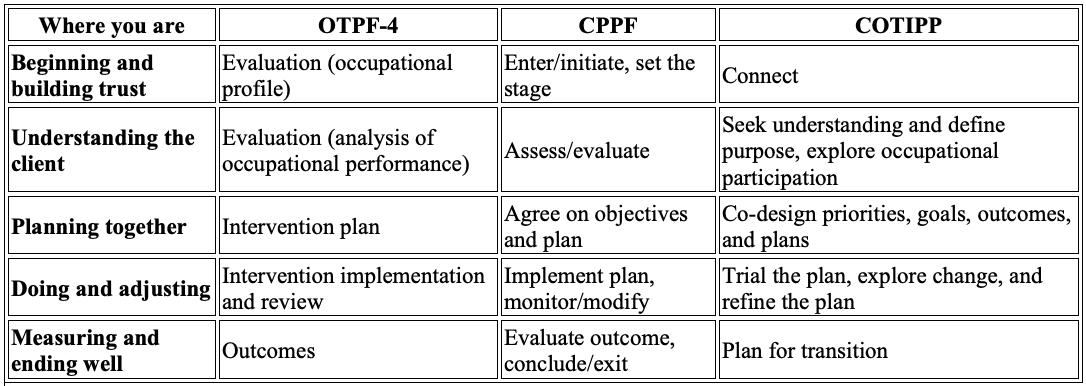
You do not need to master all three. Pick the one your setting uses (or the one that resonates) and let it hold the structure, so your mental energy can go to the client.
What is case conceptualization in occupational therapy?
Case conceptualization is your working explanation of why this person is struggling with the occupations that matter to them, organized through a model.
It is not a diagnosis, and it is not a list of problems. It is a hypothesis that connects what the client wants to do, what is getting in the way, and what seems to keep the difficulty going. Because it is a hypothesis, it is allowed to be wrong. You revise it as you learn more.
A simple sentence template I use with mentees:
[Client] wants to [engage in valued occupation], but is having difficulty because of [fit between person, occupation, and environment factors - results of barriers analysis]. [Client] has the following strengths & resources that will support them in engaging in the OT process to address these barriers: [willingness to engage in therapy/complete homework, good social support, etc.].
What is a barriers analysis?
A barriers analysis sorts everything getting in the way of occupational participation by where it lives (person, occupation, or environment) so you know where to intervene.
This is where models earn their keep. A model like the PEO, CMOP-E, or CanMOP gives you the categories. MOHO might have you ask about volition, habituation, and performance capacity instead.
A composite example: from tool-first to reasoning-first
(This is a composite example, blended from common patterns rather than any one client.)
A mentee is working with an adult living with chronic low back pain who wants to get back to cooking dinner for her family. She is exhausted, sleeping poorly, and frustrated.
The tool-first version. In the first two sessions, the client receives a pacing handout, sleep hygiene tips, a diaphragmatic breathing exercise, and general ergonomic advice. She tries a bit of each, nothing seems to stick, and the mentee comes to our session asking, "What else can I give her?"
The reasoning-first version. We go back to the occupational profile and build a barrier map using a person-occupation-environment lens:
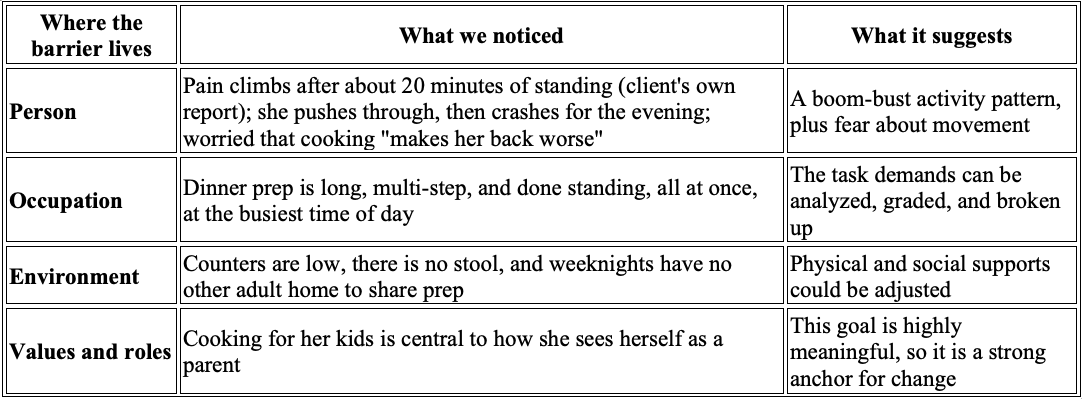
The working conceptualization: She wants to cook dinner for her family, but is having difficulty because of a poor fit between (P) pain with prolonged standing, (O) a long single-block meal prep task, and (E) limited weeknight support. The difficulty seems to be maintained by a push-through-then-crash cycle and fear that cooking causes harm. The pain may also be worsened by poor sleep and lack of coping skills/tools.
Can you see how now this easily flows to generation of what interventions we want to use?
Now the tools have a reason
Notice what happens next. The interventions might not look that different from the tool-first list, but every one of them now has a job:
Activity analysis and grading (occupation): break meal prep into chunks, move some steps earlier in the day, sit for chopping.
Environmental modification (environment): a perching stool, reorganizing frequently used items to counter height, a conversation about weekend batch cooking with her partner.
Pacing, framed around cooking (person): not a generic handout, but a plan built around her actual dinner routine.
A cognitive-behavioural frame of reference (person): gently exploring the belief that cooking is harmful, perhaps through graded exposure to standing tasks. Alternatively, you might use a pain neuroscience approach. You can see how there is not one right answer, but multiple options that could flow from one conceptualization - we love options!
An outcome measure tied to her goal, such as the Canadian Occupational Performance Measure (COPM), so you both know whether things are actually changing.
And notice what might come off the list. If sleep improves once evenings stop ending in a crash, the sleep handout may not be needed yet. Case conceptualization often helps us to know what tools to use, and also in what order. That is the gift of reasoning-first practice: fewer, better-targeted interventions and a client who can see why each one matters.
How should I approach my next client? A step-by-step guide
Pause before reaching for a tool, build the relationship, form a case conceptualization, map barriers through a model, then choosing interventions will feel obvious.
Here is the sequence I walk mentees through. It borrows from the OTPF-4, CPPF, and COTIPP, so it should fit whichever framework your setting uses.
Notice the urge to reach for a tool. When you feel the pull to hand something over, pause and ask: "What do I still need to explore or understand?" That pause is a skill, not a delay.
Connect and set the stage. Before assessing, clarify what the client hopes for, what they expect from OT, and what has or has not helped before. Offer choice about how you work together. This is where trauma-informed care and COTIPP's relationship-first focus meet.
Gather the occupational profile. What does a typical day look like? Which roles and routines matter most? What is hardest right now, and what is going well? Let the client's priorities lead.
Choose one model to organize what you learn. Pick a model you know reasonably well and that fits the setting (CMOP-E or CanMOP, PEO, MOHO, Kawa). One model, used thoughtfully, beats five used loosely. Don’t overcomplicate it.
Write your case conceptualization and barrier map. Use the sentence template I mentioned before it you like, or find your own workflow. Sort barriers into person, occupation, and environment or different categories depending on the model YOU have chosen to use. Ask yourself what keeps the difficulty going.
Co-design goals, then choose frames of reference and tools. Agree on priorities together. Then match each barrier to a frame of reference (for example, biomechanical for strength and endurance, cognitive-behavioural for unhelpful beliefs, compensatory for adapting the task). Only now do you open the toolbox.
Monitor, modify, and revisit the hypothesis. Use an outcome measure tied to the client's goal. If things are not shifting, go back to step 5 before adding more tools. A stalled plan is information, not a failure.
Reflection questions to bring to supervision or mentorship
If you are stuck with a client right now, try answering these on paper:
What does this client most want to be able to do?
What are the barriers that are getting in the way?
For each intervention I am using, which barrier is it targeting? In other words - why am I using this tool?!
What would tell us this is working?
Frequently asked questions
Do I have to use the same OT model with every client?
No. Choose the model that best fits the client, the setting, and the problem. Many OTs have one or two "home" models they know deeply and use most of the time, then pair them with whichever frames of reference match the barriers they find.
Can I use more than one frame of reference at once?
Yes, and it is very common. In the composite example above, a biomechanical lens, a compensatory lens, and a cognitive-behavioural lens all had a role. The key is knowing which barrier each one is addressing.
What is the difference between the OTPF-4 and the CPPF?
The OTPF-4 is AOTA's description of the domain and process of occupational therapy, published in 2020. The CPPF is a Canadian practice process framework from CAOT's Enabling Occupation II (2007), with eight action points. Both describe how OTs move through the work with a client.
Is the CPPF still relevant now that COTIPP exists?
COTIPP (2022) draws directly on the CPPF and the Canadian Model of Client-Centred Enablement, so the CPPF's logic is still very much present. Check what your workplace, program, or regulator references, and use the framework that helps you reason most clearly.
How long should a case conceptualization be?
There is no clear right answer here. It can be shorter than you think. A few clear sentences is a strong start. What matters is that it links the client's valued occupation, the barriers, and what keeps the difficulty going, and that you revise it as you learn more.
Is it ever okay to give a tool before I have finished assessing?
Absolutely. Safety concerns, acute distress, or an urgent need can call for a strategy right away. Reasoning-first practice does not mean withholding help. It means you can explain why you chose that tool, and you come back to the bigger picture once things settle.
The takeaway: you do not need more tools, you need a way to choose them
If you have been feeling lost with your clients, please hear this: you are not behind, and you are not a bad OT. You probably already have more tools than you need. What helps is a structure for deciding which one, when, and why.
To recap:
A practice process framework (OTPF-4, CPPF, or COTIPP) tells you where you are and what comes next.
A model helps you understand the person, their occupations, and their environment.
Case conceptualization and barriers analysis turn what you learned into a working hypothesis.
Frames of reference and tools come last, matched to the barriers you found.
Here is a small challenge for this week: pick one client you feel stuck with and write a three-sentence case conceptualization before your next session. Notice what changes in how you walk into the room.
Want support applying this to your own caseload?
What changed things for me was not another course. It was having someone in my corner while I adapted what I already knew to my real, messy, complicated caseload. That is exactly what we do together in Professional Mentorship: we take your actual clients, work through case conceptualization and barriers analysis side by side, and build your confidence one case at a time.
Sessions are one hour, online or in person. Many employers cover mentorship through professional development budgets, so it is worth asking yours. If you are a contractor, make sure you are expensing courses against your income at tax time! Take advantage of grants available through the government or your national & provincial associations that exist to help OTs continue to advance their practice. I just recently applied and was awarded the Dianna Mah Memorial grant which helped me to take a new course on Occupational Therapy treatment for Postural Orthostatic Tachycardia Syndrome (POTS).
Not ready for that step? You are welcome to grab my free clinical handouts and join the mailing list for more practical, reasoning-first resources.
About the author
Cassi Starc is a registered occupational therapist and trained mindful self-compassion teacher based in Victoria, BC, with nearly 10 years of clinical experience. Cassi runs Flourish Healthcare Education & Mindfulness, where she provides occupational therapy services, runs mindful self-compassion groups, and supports fellow clinicians through mentorship and courses. She is also a Clinical Instructor at the University of British Columbia.